Showing posts with label kernel. Show all posts
Showing posts with label kernel. Show all posts

Nov 19, 2014
User mode Linux
User mode Linux (UML, Линукс пользовательского режима) — вариант ядра Linux, который позволяет запустить несколько виртуализованных Линукс-систем (guests) в качестве обычных приложений в основной Linux‐системе (host).
http://uml.devloop.org.uk/howto.html
http://uml.devloop.org.uk/faq.html
http://user-mode-linux.sourceforge.net/index.html
Скачать root_fs, например Debian-Wheezy
Запустить:
hot-plug it into a running UML:
pCtikQ - umlid, можно найти в папке ~/.uml
uml_console
tuntap - TUN and TAP are virtual-network kernel devices. Being network devices supported entirely in software, they differ from ordinary network devices which are backed up by hardware network adapters
Tips on debugging optimized code
http://uml.devloop.org.uk/howto.html
http://uml.devloop.org.uk/faq.html
http://user-mode-linux.sourceforge.net/index.html
Запуск
Скачать ядро, скомпилировать:make defconfig ARCH=um
make ARCH=umСкачать root_fs, например Debian-Wheezy
Запустить:
host% mkdir /tmp/uml
host% TMPDIR=/tmp/uml ./linux ubda=Debian-Wheezy-AMD64-root_fs mem=1024mguest% haltНастройка сети
http://user-mode-linux.sourceforge.net/network.htmlhost% sudo aptitude install uml-utilitieshost% sudo vi /etc/group
newgrp uml-net # login to grouphot-plug it into a running UML:
pCtikQ - umlid, можно найти в папке ~/.uml
uml_console
tuntap - TUN and TAP are virtual-network kernel devices. Being network devices supported entirely in software, they differ from ordinary network devices which are backed up by hardware network adapters
host% uml_mconsole pCtikQ config eth0=tuntap,,,192.168.0.254
# or do it via bash command
host% uml_mconsole `ls -1t ~/.uml | head -n1` config eth0=tuntap,,,192.168.0.254guest% ifconfig eth0 192.168.0.253 up
guest% route add default gw 192.168.0.254host% sudo iptables -t nat -A POSTROUTING -o eth0 -j MASQUERADEЗапуск в gdb
http://web2.clarkson.edu/class/cs644/kernel/setup/uml/gdb_uml.htmlhost% TMPDIR=/tmp/uml gdb ./linux
(gdb) handle SIGSEGV pass nostop noprint
(gdb) handle SIGUSR1 pass nostop noprint
(gdb) break netlink_create
(gdb) run ubda=Debian-Wheezy-AMD64-root_fs mem=512mhandle SIGSEGV pass nostop noprint handle SIGUSR1 pass nostop noprint r ubda=Debian-Wheezy-AMD64-root_fs mem=512m
Tips on debugging optimized code
The Linux kernel and all kernel modules are always built with optimization on. This is not just for performance reasons: the kernel code requires and assumes that it is optimized and does not function otherwise.Tips on debugging optimized code
Jun 24, 2014
gcc dumpspecs
gcc -dumpspecs
# ...
# *startfile:
# %{!mandroid|tno-android-ld:%{!shared: %{pg|p|profile:gcrt1.o%s;pie:Scrt1.o%s;:crt1.o%s}}    crti.o%s # %{static:crtbeginT.o%s;shared|pie:crtbeginS.o%s;:crtbegin.o%s};:%{shared: crtbegin_so%O%s;:  %{static: crtbegin_static%O%s;: crtbegin_dynamic%O%s}}}
# ...ld --verbose
#...
# OUTPUT_ARCH(i386:x86-64)
# ENTRY(_start)
# SEARCH_DIR("/usr/x86_64-linux-gnu/lib64"); SEARCH_DIR("=/usr/local/lib/x86_64-linux-gnu"); SEARCH_DIR("=/usr/local/lib64"); SEARCH_DIR("=/lib/x86_64-linux-gnu"); SEARCH_DIR("=/lib64"); SEARCH_DIR("=/usr/lib/x86_64-linux-gnu"); SEARCH_DIR("=/usr/lib64"); SEARCH_DIR("=/usr/local/lib"); SEARCH_DIR("=/lib"); # SEARCH_DIR("=/usr/lib");
SECTIONS
# ...May 30, 2014
Kgdb, Kdb
Using kgdb, kdb and the kernel debugger internals
Kgdb is a debug stub that allows another machine to connect a source-level debugger over a serial link.
kdb reuses kgdb's breakpoint and polled I/O infrastructure in order to implement a machine-level kernel debugger that runs entirely on the machine being debugged.
Kgdb is a debug stub that allows another machine to connect a source-level debugger over a serial link.
kdb reuses kgdb's breakpoint and polled I/O infrastructure in order to implement a machine-level kernel debugger that runs entirely on the machine being debugged.
May 19, 2014
Kernel. Misc
# Options
sudo sysctl -a
less /usr/include/linux/sysctl.h
ulimit -a # Sets or reports user resource limits.
cat /proc/sys/kernel/ostype
cat /proc/sys/kernel/osrelease
ls /lib/modules/$(uname -r)/kernel/fs
List open files
lsof -p
File
stat text.txt
file arch.tar.xz
fuser -v server.sock
Inode
ls -i
df -i
Port
fuser -v -n tcp 11100
Interrupts

Timing

Page and buffer cache fadvise, madvise, readahead
 pdflush
sudo sysctl -a
less /usr/include/linux/sysctl.h
ulimit -a # Sets or reports user resource limits.
cat /proc/sys/kernel/ostype
cat /proc/sys/kernel/osrelease
ls /lib/modules/$(uname -r)/kernel/fs
List open files
lsof -p
File
stat text.txt
file arch.tar.xz
fuser -v server.sock
Inode
ls -i
df -i
Port
fuser -v -n tcp 11100
Interrupts
Timing
Page and buffer cache fadvise, madvise, readahead
Apr 27, 2014
The Linux Graphics Stack
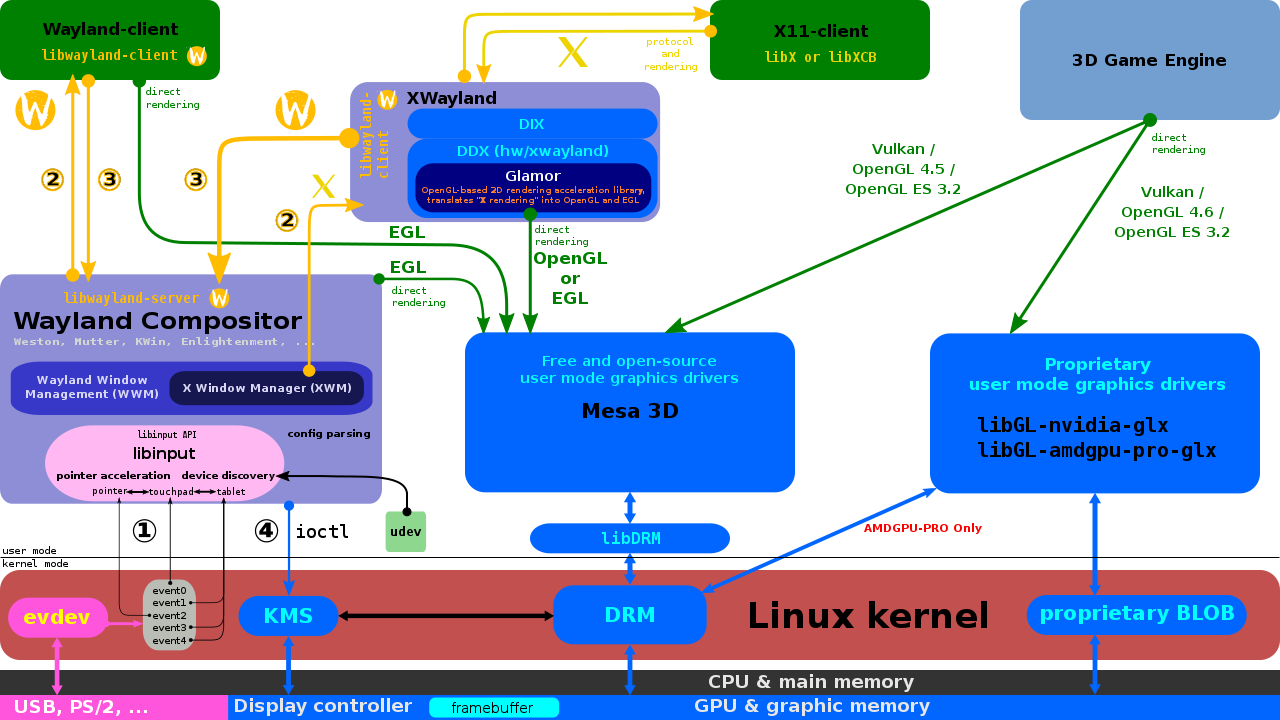
The Direct Rendering Manager (DRM) is a device-independent kernel-level device driver that provides support for the Direct Rendering Infrastructure.
Direct Rendering Infrastructure (DRI) is an interface and a free software implementation inside the kernel used by the X Window System/Wayland to securely allow user applications to access the video hardware without requiring data to be passed through the display server. Its primary application is to provide hardware acceleration for the Mesa implementation of OpenGL, which is the core of the DRI OpenGL drivers. Without DRI, programs have to use the CPU while rendering (indirect rendering), which degrades overall performance. DRI has also been adapted to provide OpenGL acceleration on a framebuffer console without a display server running.
Mode setting (KMS) is a software operation that activates a display mode (screen resolution, color depth, and refresh rate) for a computer's display adapter.
Wayland is a protocol that specifies the communication between the display server (called Wayland compositor) and its clients. It was initially designed as a replacement for the X Window System. In stark contrast to the latter, Wayland clients will render without detour directly into their own buffer located in the graphics memory, through the use of EGL with some additional Wayland-specific extensions to EGL.
The display manager is to do the compositing, hence it will incorporate a big chunk of the functionality of current-day compositing window managers. It will composite those buffers to form the on-screen display of application windows. The Wayland protocol is essentially only about input handling and buffer management. The handling of the input hardware relies on evdev in Linux, and similar components in other operating systems.
EGL is an interface between Khronos rendering APIs (such as OpenGL, OpenGL ES or OpenVG) and the underlying native platform windowing system. EGL handles graphics context management, surface/buffer binding, rendering synchronization, and enables "high-performance, accelerated, mixed-mode 2D and 3D rendering using other Khronos APIs." EGL is managed by the non-profit technology consortium Khronos Group.
evdev (for event device) is a component of the Linux kernel for handling input (from keyboards, mice, joysticks, etc.) and a closely related input driver for both the X.Org Server and Wayland compositors. The kernel component is glue code which translates input events from peripheral-specific drivers into a generic structure which the input driver can easily translate into X11 events. Thus every input device with a Linux driver is compatible with the X.Org input driver, making X.Org much easier to configure.
Mesa is a collection of free and open-source libraries that implement OpenGL and several other APIs related to hardware-accelerated 3D rendering, 3D computer graphics and GPGPU.
Mar 19, 2014
Kernel. Power management
cat /sys/module/cpuidle/parameters/off

cd /sys/devices/system/cpu/cpu0/cpuidle
cat */power
cat */usage
C-State
powertopThe cpuidle subsystem
Feb 15, 2014
Kernel. Networking
struct sk_buff
struct net_device
devices: eth ppp asdn atm
rx recieve
tz transmit
Explicit Congestion Notification (ECN) — (Явное Уведомление о Перегруженности)
IPv4
IPv6
UDP
TCP

mtu maximum transmission unit
ARP address resolution protocol
NAT network address translation; masquerading
transparent proxy
netfilter; iptables
finite state machine конечный автомат
tcpdump witeshark


struct net_device
devices: eth ppp asdn atm
rx recieve
tz transmit
Explicit Congestion Notification (ECN) — (Явное Уведомление о Перегруженности)
ls -l /sys/class/net

cat /proc/net/sockstat
cat /proc/net/dev
cat /proc/net/tcp  # ports
cat /proc/net/udp
cat /proc/net/unixIPv4
IPv6
UDP
TCP
mtu maximum transmission unit
ARP address resolution protocol
NAT network address translation; masquerading
transparent proxy
netfilter; iptables
finite state machine конечный автомат
tcpdump witeshark
tshark -V -2 -R 'ip.addr==208.118.235.148'
# http://stackoverflow.com/questions/5907527/application-control-of-tcp-retransmission-on-linux
/proc/sys/net/ipv4/tcp_retries2

man 5 socketckall

man 3 netlink
man 5 netlink
/proc/net/netlinkFeb 3, 2014
Extended file attributes, ACL
Does file system support?
Extended attributes: the good, the not so good, the bad.
On Linux and FreeBSD,
Extended Attributes – lsattr and chattr
POSIX Access Control Lists on Linux
DAC model
sudo tune2fs -l /dev/sda1 | grep "Default mount options:"
# Default mount options:    user_xattr acl
Extended attributes: the good, the not so good, the bad.
On Linux and FreeBSD,
cp will only preserve xattrs if given the option --preserve=xattr, also implied by the -a option. cp will not duplicate attributes by default, which is a reasonable default choice, even if it will be wrong in some situations (where you will have to use the options).Extended Attributes – lsattr and chattr
- a : append only
- c : compressed
- d : no dump
- e : extent format
- i : immutable
- j : data journalling
- s : secure deletion
- t : no tail-merging
- u : undeletable
- A : no atime updates
- C : no copy on write
- D : synchronous directory updates
- S : synchronous updates
- T : top of directory hierarchy
lsattr test.txt
chattr -a test.txtsetfattr -n user.comment -v "this is a comment" testfile
getfattr testfile
# user.comment
getfattr -n user.comment testfile
# user.comment="this is a comment"POSIX Access Control Lists on Linux
DAC model
man 5 acl
getfacl dir
setfacl -m user:joe:rwx dir
man chaclJan 23, 2014
Kernel. Modules, program exec, syscalls, elf
man 2 syscallsstrace -e trace=open date
strace -c date
ltrace -T -S rmdir t
ltrace -c -S rmdir t
ldd `which python`# view headers, section...
readelf -a a.out
readelf --sections=vmlinux a.out
readelf --dynamic a.out
# disassembly
objdump -M intel -S a.out
# list symbols from object files
nm a.out
# dependencies resolved from this list
cat /proc/kallsyms | grep printk
cat /boot/System.map-3.13.0 | grep printk
stat a.out
file a.out# list modules
lsmod
# Modules dependencies
cat /lib/modules/3.12.7/modules.dep | grep vboxdrv
man depmod
# info
modinfo vboxdrv
# view system device information
systool -v -m vboxdrvsys_init_module() -> load_module()
sys_delete_module()
request_module()
hello world module
man 2 init_module
man 2 delete_module

# which module loader
cat /proc/sys/kernel/modprobe
sudo sysctl -a | grep modprobe

man modprobe
man insmod
man rmmod

ll /sbin/udevd

udevadm monitor
cat /proc/sys/kernel/taintined
dmesg | grep taintLinux kernel. Devices and drivers
cat /proc/partitions
cat /proc/devices
tmpfs
df -h # tmpfs and subfolders vps aux | grep [u]dev # demons
udevadm monitor # new devicesstruct gendisk
add_disk()
struct block_device
struct block_device_operations
struct request_queue
struct request
sumit_bio()
generic_make_request
Linux I/O Scheduler
struct elevator_ops
vfs_ioctl() - call filesystem specific ioctl methods
man 2 ioctl # control deviceI/O ports and I/O memmory vs DMA
IOMMU
cat /proc/ioports
cat /proc/mem
struct bus_type
bus_register()
sysfs vs Kernfs introduced in 3.14
ll /sys/block
ll /sys/bus/pci/ISA, PCI, PCI Express
struct pci_bus

struct pci_driver


Vfs
struct inode
struct inode_operations
dmesg|grep Inode
#[    0.001283] Inode-cache hash table entries: 262144 (order: 9, 2097152 bytes)
struct file_struct - opened by process
struct file
struct file_operations
RCU
struct dentry
struct dentry_operations
NFS, AFS, SMB (CIFS)
struct super_block
mount
ll /dev/disk/by-*ramfs, tmpfs, sysfs, procfs, debugfs
CONFIG_DEBUG_FS
cat /proc/filesystems
ll /proc/buddyinfo
cat /proc/buddyinfo
cat /proc/slabinfo
sudo cat /proc/slabinfo
cat /proc/vmstat
cat /proc/kallsyms
ll /proc/kcore  # + gdb, ddd
cat /proc/interrupts
sys_open() - adds fd to current->fs
ACL
Ext2 reservation window


writeback, ordered, journal
Jan 21, 2014
Arch
OpenRISC — открытый микропроцессор архитектуры RISC с открытым исходным кодом на языке описания аппаратного обеспечения Verilog. Проект создан сообществом OpenCores и распространяется по лицензии GNU LGPL. OpenRISC воплощён аппаратно и успешно производится в виде интегральных микросхем и ПЛИС (PLD).
SPARC - SPARC (Scalable Processor ARChitecture — масштабируемая архитектура процессора) — архитектура RISC-микропроцессоров, первоначально разработанная в 1985 году компанией Sun Microsystems.
МЦСТ R1000 (NUMA)
ARM (Advanced RISC Machine, Acorn RISC Machine, усовершенствованная RISC-машина) — семейство лицензируемых 32-битных и 64-битных микропроцессорных ядер разработки компании ARM Limited.
MIPS (англ. Microprocessor without Interlocked Pipeline Stages) — микропроцессор, разработанный компанией MIPS Computer Systems (в настоящее время MIPS Technologies) в соответствии с концепцией проектирования процессоров RISC (то есть для процессоров с сокращенным набором команд).
DEC Alpha (также известный как Alpha AXP) — 64-разрядный RISC микропроцессор, первоначально разработанный и произведённый компанией DEC, которая использовала его в собственной линейке рабочих станций и серверов.
PowerPC (или сокращённо PPC) — микропроцессорная RISC-архитектура, созданная в 1991 году альянсом компаний Apple, IBM и Motorola, известным как AIM.
IA-64 (also called Intel Itanium architecture) is the architecture of the Itanium family of 64-bit of Intel microprocessors. The architecture originated at Hewlett-Packard (HP), and was later jointly developed by HP and Intel.
The Itanium architecture is based on explicit instruction-level parallelism, in which the compiler decides which instructions to execute in parallel. This contrasts with other superscalar architectures, which depend on the processor to manage instruction dependencies at runtime. In all Itanium models, up to and including Tukwila, cores execute up to six instructions per clock cycle. The first Itanium processor, codenamed Merced, was released in 2001.
IA-32 (i386) (Intel Architecture, 32-bit, sometimes called i386 through metonymy) is the title of the third generation of x86 architecture, first implemented in the Intel 80386 microprocessors in 1985. It was the first incarnation of x86 to support 32-bit computing. As such, "IA-32" may be used as a metonym to refer to all x86 versions that supported 32-bit computing.
x86-64 (x64) — 64-битная аппаратная платформа (чипсет и архитектура набора команд), разработанная компанией AMD для выполнения 64-разрядных приложений.
Это расширение архитектуры x86 с почти полной обратной совместимостью.
List of Linux supported architectures
Modern Microprocessors. A 90 Minute Guide!
SPARC - SPARC (Scalable Processor ARChitecture — масштабируемая архитектура процессора) — архитектура RISC-микропроцессоров, первоначально разработанная в 1985 году компанией Sun Microsystems.
МЦСТ R1000 (NUMA)
ARM (Advanced RISC Machine, Acorn RISC Machine, усовершенствованная RISC-машина) — семейство лицензируемых 32-битных и 64-битных микропроцессорных ядер разработки компании ARM Limited.
MIPS (англ. Microprocessor without Interlocked Pipeline Stages) — микропроцессор, разработанный компанией MIPS Computer Systems (в настоящее время MIPS Technologies) в соответствии с концепцией проектирования процессоров RISC (то есть для процессоров с сокращенным набором команд).
DEC Alpha (также известный как Alpha AXP) — 64-разрядный RISC микропроцессор, первоначально разработанный и произведённый компанией DEC, которая использовала его в собственной линейке рабочих станций и серверов.
PowerPC (или сокращённо PPC) — микропроцессорная RISC-архитектура, созданная в 1991 году альянсом компаний Apple, IBM и Motorola, известным как AIM.
IA-64 (also called Intel Itanium architecture) is the architecture of the Itanium family of 64-bit of Intel microprocessors. The architecture originated at Hewlett-Packard (HP), and was later jointly developed by HP and Intel.
The Itanium architecture is based on explicit instruction-level parallelism, in which the compiler decides which instructions to execute in parallel. This contrasts with other superscalar architectures, which depend on the processor to manage instruction dependencies at runtime. In all Itanium models, up to and including Tukwila, cores execute up to six instructions per clock cycle. The first Itanium processor, codenamed Merced, was released in 2001.
IA-32 (i386) (Intel Architecture, 32-bit, sometimes called i386 through metonymy) is the title of the third generation of x86 architecture, first implemented in the Intel 80386 microprocessors in 1985. It was the first incarnation of x86 to support 32-bit computing. As such, "IA-32" may be used as a metonym to refer to all x86 versions that supported 32-bit computing.
x86-64 (x64) — 64-битная аппаратная платформа (чипсет и архитектура набора команд), разработанная компанией AMD для выполнения 64-разрядных приложений.
Это расширение архитектуры x86 с почти полной обратной совместимостью.
List of Linux supported architectures
Modern Microprocessors. A 90 Minute Guide!
Jan 17, 2014
Kernel and Hardware Abbriviations
ASMP - Asymmetric multiprocessing
SMP - Symmetric Multiprocessing
Регистр процессора
OOO - Внеочередное исполнение (англ. Out-of-order execution) likely, unlikely
Кэш процессора
Алгоритмы кэширования: LRU - Least Recently Used; MRU - Most Recently Used
Выравнивание данных
UMA - Uniform Memory Access
NUMA - Non-Uniform Memory Access
BIOS SLIC - Software Licensing Description Table
UEFI, EFI Extensible Firmware Interface (англ. Расширяемый интерфейс прошивки) — интерфейс между операционной системой и микропрограммами, управляющими низкоуровневыми функциями оборудования, его основное предназначение: корректно инициализировать оборудование при включении системы и передать управление загрузчику операционной системы. EFI предназначен для замены BIOS — интерфейса, который традиционно используется всеми IBM PC-совместимыми персональными компьютерами.
ACPI - Advanced Configuration and Power Interface — усовершенствованный интерфейс управления конфигурацией и питанием. Suspend, Hibernate
e820 - Функция прерывания 15H BIOS персонального компьютера, использующаяся для получения информации о распределении адресного пространства, имеющейся оперативной памяти и зарезервированных адресах.
DMI - (Desktop Management Interface) — интерфейс программирования приложений (API), позволяющий программному обеспечению собирать данные о характеристиках компьютера. dmidecode
RAM
ROM - Постоянное запоминающее устройство (ПЗУ)
MMU - Блок управления памятью или устройство управления памятью (англ. memory management unit)
PAE - Physical Address Extension — режим работы встроенного блока управления памятью x86-совместимых процессоров, в котором используются 64-битные элементы таблиц страниц, c помощью которых процессор может адресовать 64 ГБ физической памяти (вместо 4 ГБ, адресуемых при использовании 32-разрядных таблиц), хотя каждая задача (программа) всё равно может адресовать максимум до 4 ГБ виртуальной памяти. Также, в новых моделях процессоров в PAE-режиме старший бит элемента таблицы страниц отвечает за запрет исполнения кода в странице, что затрудняет атаку по методу переполнения буфера.
NX bit - No eXecute Bit
PSE - Page Size Extension (PSE) — режим работы встроенного блока управления памятью x86-совместимых процессоров, в котором используются страницы размером в 4 (32-битные таблицы страниц) или 2 мегабайта (PAE/AMD64, 64-битные таблицы), в дополнение к обычным страницам x86 архитектуры в 4 килобайта.
DMA - Прямой доступ к памяти
TLB - Буфер ассоциативной трансляции (англ. Translation lookaside buffer, TLB) — это специализированный кэш центрального процессора, используемый для ускорения трансляции адреса виртуальной памяти в адрес физической памяти.
PGD - Global
PUD - Upper
PMD - Middle
PTE- Page Table entry
Slab Slub Slob
ASLR Address space layout randomization — технология, применяемая в операционных системах, при использовании которой случайным образом изменяется расположение в адресном пространстве процесса важных структур, а именно: образа исполняемого файла, подгружаемых библиотек, кучи и стека.
Completely Fair Scheduler
Round robin scheduling
FIFO - First In, First Out /usr/include/x86_64-linux-gnu/sys/queue.h
Jan 3, 2014
Linux kernel. Scheduler
priority to load weight
load balancing, kmigrate
run queues, sched entities:
SCHED_FIFO uses a first in, first out mechanism
New in 3.14
Earliest deadline first scheduling

load balancing, kmigrate
run queues, sched entities:
cat /proc/sched_debug
# Sched Debug Version: v0.11, 3.13.6 #4
# ktime                                   : 11620320.261793
# sched_clk                               : 11629180.728702
# cpu_clk                                 : 11629180.728834
# jiffies                                 : 4297797377
# sched_clock_stable                      : 1
#
# cpu#0, 3077.541 MHz
#   .nr_running                    : 0
#   .load                          : 0
#   .nr_switches                   : 10802526
#   .nr_load_updates               : 1998334
#   .nr_uninterruptible            : -2228
#   .next_balance                  : 4297.797394
# .....
# rt_rq[0]:/
#   .rt_nr_running                 : 0
#   .rt_throttled                  : 0
#   .rt_time                       : 0.011064
#   .rt_runtime                    : 950.000000
#
# runnable tasks:
#             task   PID         tree-key  switches  prio     exec-runtime ...
# ------------------------------------------------------------------------ ...
#      ksoftirqd/0     3    875652.689495     83449   120    875652.689495 ...
#     kworker/0:0H     5      3837.050667         6   100      3837.050667 ...
#        rcu_sched     7    875652.806577    388480   120    875652.806577 ...
sudo cat /proc/schedstat
cat /proc/PID/sched
cat /proc/PID/limits
ls /proc/sys/kernel | grep sched
sudo sysctl -A | grep schedsudo chrt -r -p 90 22336SCHED_FIFO uses a first in, first out mechanism
schedtool -hstruct thread_infostruct task_structstruct nsproxydo_fork()do_execve()kernel_thread()struct sched_classstruct rqstruct sched_entityscheduler_tick()context_switch()struct sched_class fair_sched_classcheck_preempt_tick()struct sched_class rt_sched_classtask_tick_rt()New in 3.14
Earliest deadline first scheduling
struct sched_class dl_sched_classtask_tick_dl()find_busiest_queue() compares rqs load weightsDec 19, 2013
Dec 14, 2013
Пример работы с подсистемой Inotify ядра Linux в Python
Alexander Verbitsky
Пример работы с подсистемой Inotify ядра Linux в Python. Аналогичная реализация есть в twisted (http://twistedmatrix.com/documents/current/api/twisted.internet.inotify.html)
Пример работы с подсистемой Inotify ядра Linux в Python. Аналогичная реализация есть в twisted (http://twistedmatrix.com/documents/current/api/twisted.internet.inotify.html)
Dec 5, 2013
Linux I/O Scheduler
Selecting a Linux I/O Scheduler
How do I change I/O scheduler?
How do I change I/O scheduler?
cat /sys/block/sda/queue/scheduler
echo noop > /sys/block/sda/queue/schedulerGRUB_CMDLINE_LINUX_DEFAULT="quiet splash"GRUB_CMDLINE_LINUX_DEFAULT="quiet splash elevator=noop"sudo update-grub2
Subscribe to:
Posts (Atom)